
Prepare to provide critical care when it matters most. Blue Ridge Community College offers emergency medical services education for students beginning their training, current EMS professionals advancing their credentials, and students pursuing an associate degree and a career as a paramedic.
Blue Ridge Community College offers both workforce training in Emergency Medical Services (EMS) and a college degree in Emergency Medical Sciences.
Build the knowledge and hands-on skills needed for Emergency Medical Responder, Emergency Medical Technician, Advanced EMT, or Paramedic credentials. Additional courses are available for current professionals, organizations, and community members.
Prepare to enter the workforce as a paramedic while earning an associate degree. The program combines classroom instruction, practical laboratory sessions, hospital clinical experience, and field internships with emergency medical service agencies.
Blue Ridge Community College’s Paramedic program prepares EMTs and AEMTs for the realities of emergency medical services through rigorous, hands-on training and real-world experience. Students develop advanced clinical skills, critical-thinking abilities, and confidence in high-pressure environments.
Completion of one of the following is required prior to the start date: Anatomy and Physiology I & II (A&P 168 and 169), or A&P 163 (online)
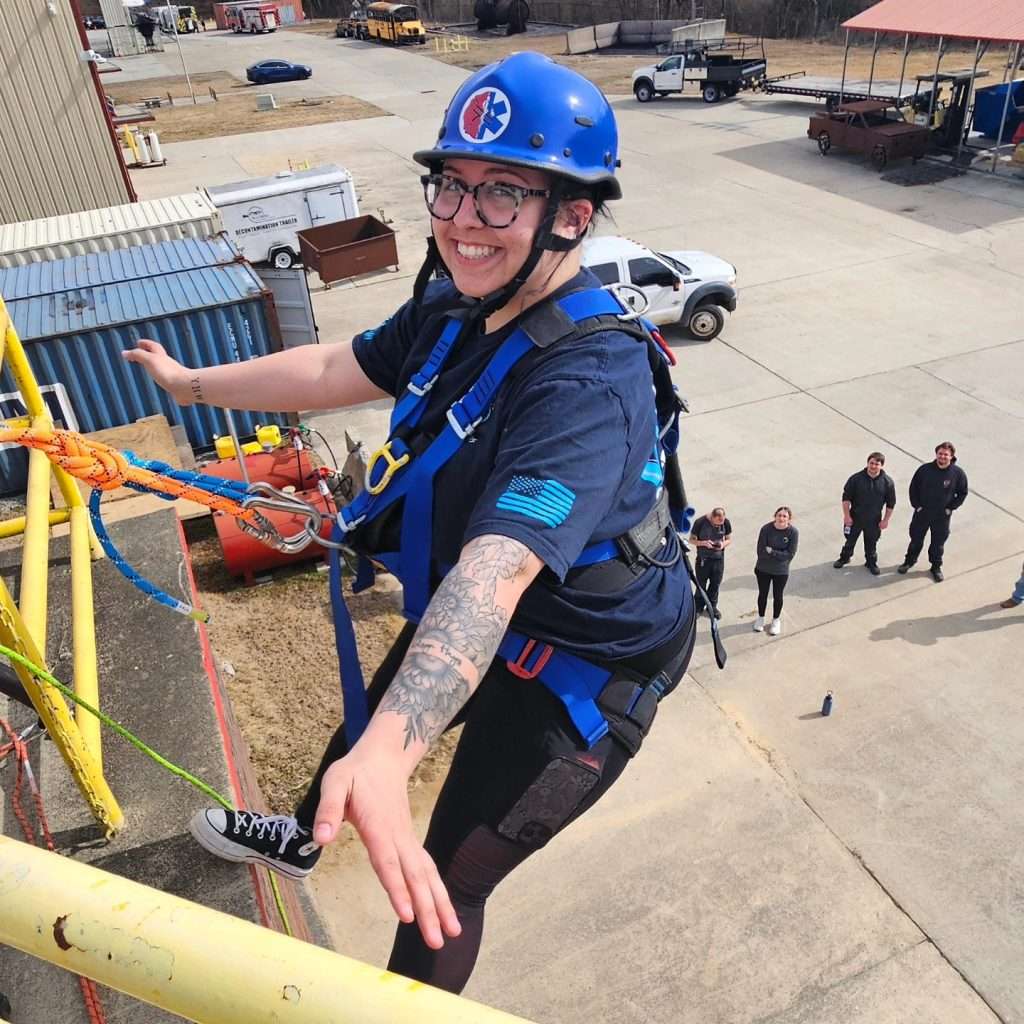
Emergency services training is available for students entering the profession and current providers advancing their credentials. Courses meet or exceed the requirements established by the North Carolina Office of Emergency Medical Services for each individual class.
Training options include:
Emergency Medical Responders provide immediate lifesaving care to critical patients who access the emergency medical services system. EMRs have the knowledge and skills necessary to provide immediate lifesaving interventions while awaiting additional EMS resources to arrive. EMRs also provide assistance to higher-level personnel at the scene of emergencies and during transport.
Under medical oversight, Emergency Medical Responders perform basic interventions with minimal equipment.
Student Prerequisites
Emergency Medical Technicians provide out-of-hospital emergency medical care and transportation for critical and emergent patients who access the emergency medical services system. EMTs have the basic knowledge and skills necessary to stabilize and safely transport patients ranging from non-emergency and routine medical transports to life-threatening emergencies.
Emergency Medical Technicians function as a part of the comprehensive EMS response system under medical oversight. They perform interventions with the basic equipment typically found on an ambulance and serve as a critical link between the scene of an emergency and the health care system.
Student Prerequisites
This course follows guidelines established by the North Carolina Office of Emergency Medical Services.
The primary focus of the Advanced Emergency Medical Technician is to provide basic and limited advanced emergency medical care and transportation for critical and emergent patients who access the emergency medical system. AEMTs possess the knowledge and skills necessary to provide patient care and transportation as part of a comprehensive EMS response under medical oversight.
Advanced Emergency Medical Technicians perform interventions with the basic and advanced equipment typically found on an ambulance. The AEMT is a link from the scene to the emergency health care system.
Student Prerequisites
The Paramedic is an allied health professional whose primary focus is to provide advanced emergency medical care for critical and emergent patients who access the emergency medical system. This individual possesses the complex knowledge and skills necessary to provide patient care and transportation.
Paramedics function as part of a comprehensive EMS response under medical oversight. They perform interventions with the basic and advanced equipment typically found on an ambulance. The Paramedic is a link from the scene into the health care system.
Student Prerequisites
This course is designed to instruct the layperson or professional responder in the basics of First Aid and Cardiopulmonary Resuscitation (CPR), with a focus on cardiac, breathing, and other life-threatening medical emergencies as well as awareness of the hazards of blood borne pathogens. Upon successful completion, the student may qualify to receive certification through a certifying agency.
This class provides emergency response personnel with training needed to meet the requirements for an infection control policy, NFPA 1581, and the Ryan White Comprehensive AIDS Resources Emergency Act. Participants receive training for their role in responding to an infection-control situation.
NAEMT’s Prehospital Trauma Life Support is recognized internationally as a leading continuing education program for prehospital emergency trauma care. The program promotes excellence in trauma patient management for providers involved in the delivery of prehospital care.
PHTLS is developed by NAEMT in cooperation with the American College of Surgeon’s Committee on Trauma, which provides medical direction and content oversight. The course emphasizes treatment of the multisystem trauma patient and promotes critical thinking as the foundation for quality trauma care.
Pediatric Education for Pre-Hospital Providers is a 14- to 16-hour course covering the knowledge and skills used in paramedic pre-hospital pediatric practice. Because it is an advanced life support course, the material assumes a minimum basic life support background in pre-hospital pediatric care.
Topics include guidelines, self-assessment cases, airway management in children, and core pediatric procedures. Skill stations include airway management, vascular access and drug administration, family communication, immobilization and restraint, and newborn resuscitation. The program is coordinated with the North Carolina Office of Emergency Medical Services.
Blue Ridge Community College’s Public Safety Training Division offers two types of American Heart Association training: group training sessions and individual skills checks following online training. Please visit the American Heart Association’s official website for course content and requirements information.
Organizations, departments, and other groups of six or more participants may request an American Heart Association-certified training session. Submit the group training request form, and a member of the Public Safety Training team will contact you to discuss scheduling and pricing.
Individuals seeking certification in one or more disciplines must first complete the appropriate online American Heart Association Essentials course. After successfully completing the online course, participants may schedule the required in-person skills check.
Blue Ridge provides individual skills checks only for participants who purchased the corresponding Essentials course through its training center.
For more information, email aha@blueridge.edu or call (828) 694-1786 during the College’s operating hours.
The Emergency Medical Science curriculum is designed to prepare graduates to enter the workforce as paramedics. The program also provides an associate degree for individuals seeking career preparation or advancement.
The course of study allows students to acquire basic and advanced life-support knowledge and skills through classroom instruction, practical laboratory sessions, hospital clinical experience, and field internships with emergency medical service agencies.

Emergency Medical Science graduates may pursue opportunities across emergency response, health care, education, industry, and public service.
Employment settings include:
Public Safety — Associate in Applied Science
The Pre-Paramedic pathway helps students complete the academic coursework and entry requirements needed for the Paramedic program. Students become eligible to enter a Paramedic cohort after successfully completing the applicable requirements.
Continuing Education-to-Curriculum credit may be available for previous emergency medical training. Students should consult an academic advisor to determine the appropriate sequence of courses.
Emergency Medical Science — Associate in Applied Science
The Paramedic Degree Completion pathway is designed for students who completed EMS training through a North Carolina community college continuing education program and hold a current North Carolina or National Registry Paramedic credential.
Eligible students receive curriculum credit for qualifying EMS Continuing Education courses and complete the remaining requirements for the Emergency Medical Science associate degree.
Start Your EMS Education in High School
Eligible North Carolina high school students may begin Emergency Medical Science coursework tuition-free through the Career and College Promise program.
Continue Your Education at Western Carolina University
Eligible graduates may have an opportunity to continue their education through a bachelor’s degree pathway at Western Carolina University.
Ask your advisor for additional transfer pathway information.
The Emergency Medical Science Program is accredited by the
Commission on Accreditation of Allied Health Education Programs (CAAHEP)
1361 Park Street, Clearwater, FL 33756
Phone: (727) 210-2350 | Fax: (727) 210-2354
www.caahep.org
by the recommendation of the
Committee on Accreditation of Educational Programs for the Emergency Medical Services Profession
8301 Lakeview Parkway, Suite 113-312, Rowlett, TX 75088
www.coaemsp.org
Graduates will take the North Carolina Office of Emergency Medical Services examination. Graduates will also be eligible to take the National Registry of Emergency Medical Technicians examination for Paramedic.
Programs accredited by the Commission on Accreditation of Allied Health Education Programs are required to meet outcome benchmarks each year. Outcomes include, but are not limited to, North Carolina Office of Emergency Medical Services (NCOEMS) and National Registry of Emergency Medical Technicians (NREMT) examinations.
| Graduating Class | # of Graduates | NCOEMS Pass Rate | Retention Rate | Employment Rate |
|---|---|---|---|---|
| 2025 | 6 | 6/6 — 100% | 6/7 — 85.7% | 6/6 — 100% |
| 2024 | 10 | 10/10 — 100% | 10/13 — 77% | 10/10 — 100% |
| 2023 | 12 | 12/12 — 100% | 12/22 — 55% | 8/9 — 90% |
| 2022 | 9 | 8/9 — 90% | 9/15 — 60% | 8/9 — 90% |
| 2021 | 4 | 4/4 — 100% | 4/12— 33% | 4/4 — 100% |
Whether you are beginning your EMS education, advancing in an existing credential, or pursuing an associate degree, Blue Ridge Community College can help you identify the appropriate next step.
Public Safety Training
(828) 694-1786
publicsafetytraining@bluridge.edu
Students enrolling in these programs must meet specific emotional, behavioral, physical, and cognitive standards. This information is found in Technical Standards. Students qualifying for special accommodations to these standards must contact Student Accessibility Services at (828) 694-1813 or access@blueridge.edu for more information.
 myCanvas